Principles of Animation
Squash and stretch
 This action gives the illusion of weight and volume to a object as it moves. Squash and stretch can also be used in animating dialogue and doing facial expressions. How much squash and stretch is used, depends on what is required in animating the scene
Anticipation
This movement prepares the audience for a certain action the person is about to do, for example starting to run or jump. When a dancer leaps, they don't just leap off the floor. She does a backwards motion before she does a forward motion. The backward motion is the anticipation. Also a comic effect can be done by not using anticipation. All real action has major or minor anticipation, for example a pitcher's wind-up or a golfers' back swing.
Staging

STRAIGHT AHEAD AND POSE TO POSE ANIMATION
Straight ahead animation begins at the first drawing and works drawing to drawing to the end of a scene. However, you can lose size, volume and proportions this way, but it does have spontaneity and freshness. Pose to Pose is more planned out animation. It is charted with key drawings done at intervals throughout the scene. With this animation size, volumes and proportions are controlled better, as well as the action.
FOLLOW THROUGH AND OVERLAPPING ACTION
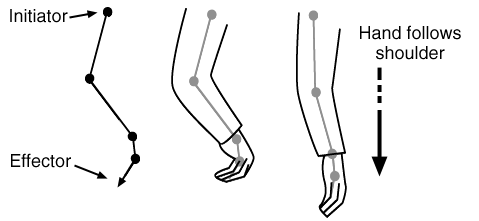 Nothing stops all at once.
When the main body of the character stops all other parts of the character
continue to catch up to the main mass of the character, for example arms, long
hair or clothing. Overlapping is the action when a character changes direction
while its clothes continues forward. The character is going in a new direction,
which is then followed by his clothes in the new direction, a number of frames
later.
Nothing stops all at once.
When the main body of the character stops all other parts of the character
continue to catch up to the main mass of the character, for example arms, long
hair or clothing. Overlapping is the action when a character changes direction
while its clothes continues forward. The character is going in a new direction,
which is then followed by his clothes in the new direction, a number of frames
later.ARCS
Most actions follow an arc or slightly circular path, especially with the actions of the human figure and animals, such as arm movements, eye movements and head turns. Arcs give animation a natural action with a better flow.
SECONDARY ACTION
This action adds to the main action and creates more dimension to the character, re-enforcing the main action.
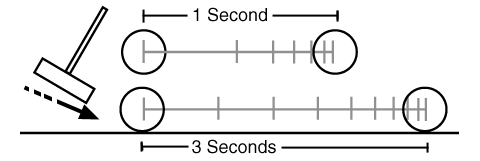
Timing is the number of drawings or frames for each action, which then leads to the speed of the action on film. The right timing makes objects appear to obey the laws of physics, for example how an object reacts to, lets say, a push depends on the objects weight. Also timing is important for showing a character's mood and emotion, as well as showing aspects of a its personality.

No comments:
Post a Comment